
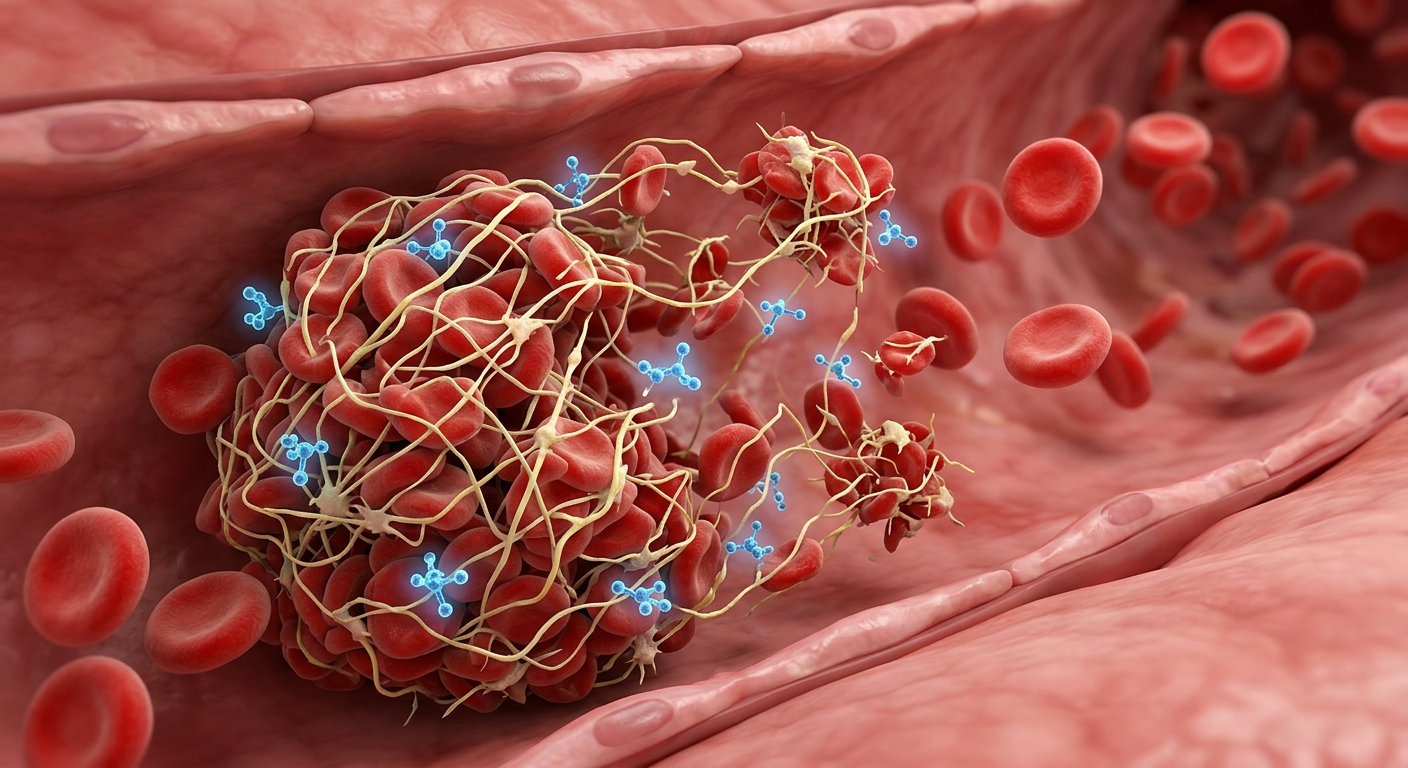
If you’ve come to this page, you likely know the basics of anticoagulation but are looking to expand that knowledge for better clinical practice. Xarelto and Eliquis are both direct oral anticoagulants (DOACs) that directly bind clotting factor Xa to reduce fibrin clot formation. Therefore, they are often used in disease states like stroke prevention in atrial fibrillation (AF) and DVT/PE prophylaxis or treatment, but how do you know when to select one over the other? Let’s break it down and compare rivaroxaban versus apixaban.
Xarelto
Dosing
- 2.5 mg twice daily, taken with food
- Lower doses are used when Xarelto is combined with aspirin ± clopidogrel in CAD/PAD.
- Ranges from 10-20 mg daily with food
- Used for conditions like atrial fibrillation, or thrombotic events (DVT/PE/HIT).
| Renal Impairment | Liver Impairment | Obesity Recommendations |
| CrCl <30 mL/min: Avoid use and choose an alternative In AF, if CrCl <50 mL/min, give 15 mg daily | Child-Turcotte-Pugh class B or C: Use not recommended | Class 1, 2 or 3 (BMI ≥ 30 kg/m2): No dose adjustment necessary |
Eliquis
Dosing
- Ranges from 2.5 mg twice daily to 10 mg twice daily
- Higher doses are usually for VTE treatment
| Renal Impairment | Liver Impairment | Obesity Recommendations |
| In AF, 2.5 mg BID is recommended if patients have at least 2 of the following: SCr ≥1.5 mg/dL, ≥ 80 years old≤, 60 kg In DVT, no dose adjustment is recommended unless severe renal impairment (limited data). | Child-Turcotte-Pugh class A or B: No dose adjustment necessary Child-Turcotte-Pugh class C: Avoid use | Class 1, 2 or 3 (BMI ≥ 30 kg/m2): No dose adjustment necessary |
General Comparison
In terms of dosing, Xarelto is usually taken once daily and taken with food, whereas Eliquis is taken twice daily with or without food. Twice-daily dosing may present adherence issues for some patients. Xarelto is taken once daily, which may result in variability of peak and trough levels compared to Eliquis. This may partially explain why observational studies have seen lower rates of bleeding with Eliquis in AF populations. A new study from The New England Journal of Medicine (COBRRA trial) assessed bleed risk between these agents in patients with VTE and found that those treated with Eliquis had lower rates of bleeding. On the other hand, Xarelto has additional indications for coronary/peripheral artery disease (CAD and PAD) that Eliquis does not have. In terms of drug-drug interactions, both are metabolized through CYP3A4 and are P-gp substrates. Eliquis has greater CYP3A4 metabolism, so its drug concentrations may be more affected when used in combination with P-gp and strong CYP3A4 inhibitors compared to Xarelto. Xarelto is also non-dialyzable, whereas Eliquis has about 4% removed over a 4 hour period of hemodialysis. As far as excretion, both are significantly excreted through the urine, but Xarelto has about 36% unchanged compared to approximately 27% for Eliquis.
Rivaroxaban Versus Apixaban Comparison in Obesity
Obesity has become a point of interest for many pharmacists due to the potential for an increased volume of distribution and altered exposure, which may reduce the efficacy of DOACs. Direct comparison studies have shown that there was not a clinically meaningful difference between the two drugs in obese patients in terms of rate of stroke, TIA, MI, atrial thrombosis, or adverse events (bleeding). Some studies suggest that Xarelto may have a better safety profile in terms of lower mortality compared to Eliquis. Newer data from the International Society on Thrombosis and Haemostasis (ISTH) have suggested that DOACs may be used in patients with a BMI up to 40-50 kg/m2 or >120 kg.
Comparison in Renal Impairment
Eliquis is generally preferred to Xarelto in stage 4-5 renal impairment (excellent board exam nugget) due to its lower renal clearance (warfarin is also a consideration). In Xarelto clinical trials, patients with CrCl 30-50 mL/min were given 15 mg daily, which resulted in levels similar to those of patients without renal impairment dosed at 20 mg daily. Patients with CrCl <30 mL/min were not studied, but a dose of 15 mg daily is expected to result in levels similar to those with CrCl 30-50 mL/min (per package insert). It was also not studied in patients on dialysis. Per the Eliquis package insert, dose adjustments are only recommended if serum creatinine is ≥1.5 mg/dL and also ≥ 80 years old or ≤60 kg. Use of Eliquis was not studied in CrCl <15 mL/min or in those on dialysis. Overall, if CrCl is 15-29 mL/min, Eliquis is preferred to Xarelto but may need a dose reduction as indicated earlier.
When we consider all these factors together, it seems like Eliquis may be a better choice when patients have concomitant disease. What have your real-world experiences with these drugs been?
This article was written by Maddie Detra, PharmD Candidate in collaboration with Eric Christianson, PharmD, BCPS, BCGP
Resources
- https://pmc.ncbi.nlm.nih.gov/articles/PMC11287953/
- https://www.jthjournal.org/article/S1538-7836(22)01848-7/fulltext
- https://pmc.ncbi.nlm.nih.gov/articles/PMC10774013/#:~:text=Underweight%2C%20defined%20as%20a%20BMI,susceptibility%20to%20potential%20adverse%20events.&text=To%20support%20physicians%20in%20their,and%20betrixaban%20are%20largely%20unavailable.
- https://www.accessdata.fda.gov/drugsatfda_docs/label/2011/202439s001lbl.pdf
- https://www.accessdata.fda.gov/drugsatfda_docs/label/2012/202155s000lbl.pdf
- https://www-nejm-org.ezp2.lib.umn.edu/doi/10.1056/NEJMoa2510703?url_ver=Z39.88-2003&rfr_id=ori:rid:crossref.org&rfr_dat=cr_pub%20%200pubmed
- Uptodate for general information on both drugs


0 Comments